SQUASH
X
PHYSICS
A Biomechanical Analysis of Squash Techniques
Through the Lens of Classical Mechanics
"It's not about hitting the ball — it's about applying physics."
Introduction: Where Squash Meets Physics
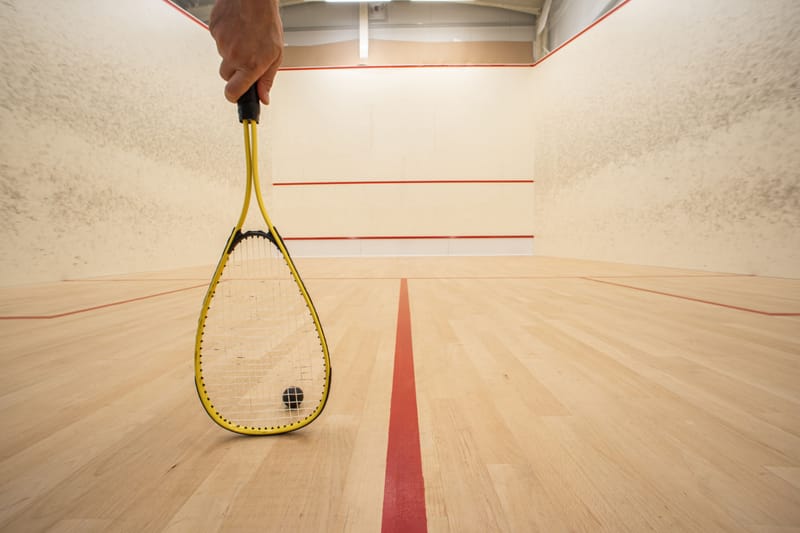
Squash is a racket sport played in a four-walled court where players take turns hitting a small rubber ball against the front wall. While it may appear simple, the sport is a rich laboratory of Newtonian mechanics, rotational dynamics, energy conservation, collision theory, and fluid dynamics.
This website applies physics concepts from foundational Newtonian mechanics and rotational dynamics to fluid dynamics and calculus-based analysis to each squash technique, analyzing how to physically optimize your play.
This website applies physics concepts from foundational Newtonian mechanics and rotational dynamics to fluid dynamics and calculus-based analysis to each squash technique, analyzing how to physically optimize your play.
Forehand Drive
The forehand drive is the most fundamental and powerful shot in squash, involving a sequential kinetic chain that maximizes racket head velocity.
The Kinetic Chain: Shoulder → Elbow → Wrist
Force generated from the lower body transfers through trunk rotation to the shoulder, then elbow, then wrist. Each joint accelerates sequentially, and the racket head velocity is the sum of all these rotational contributions. This is the physics behind the coaching cue 'use your arm like a whip.'
Energy Transfer
The racket-ball collision is never perfectly elastic. Some kinetic energy is inevitably lost to ball deformation, sound, and heat. Both translational kinetic energy (from the racket's linear speed) and rotational kinetic energy (from the wrist snap) contribute. Striking at the sweet spot with proper face angle minimizes these losses.
The Sweet Spot: Center of Percussion The sweet spot is where the impulsive reaction force at the grip vanishes upon impact. At the Center of Percussion, the ball's impact produces pure rotation about the hand with no translational jolt transmitted to the grip. Its distance from the grip depends on the racket's moment of inertia, total mass, and center of mass location.
The Kinetic Chain: Shoulder → Elbow → Wrist
Force generated from the lower body transfers through trunk rotation to the shoulder, then elbow, then wrist. Each joint accelerates sequentially, and the racket head velocity is the sum of all these rotational contributions. This is the physics behind the coaching cue 'use your arm like a whip.'
Energy Transfer
The racket-ball collision is never perfectly elastic. Some kinetic energy is inevitably lost to ball deformation, sound, and heat. Both translational kinetic energy (from the racket's linear speed) and rotational kinetic energy (from the wrist snap) contribute. Striking at the sweet spot with proper face angle minimizes these losses.
The Sweet Spot: Center of Percussion The sweet spot is where the impulsive reaction force at the grip vanishes upon impact. At the Center of Percussion, the ball's impact produces pure rotation about the hand with no translational jolt transmitted to the grip. Its distance from the grip depends on the racket's moment of inertia, total mass, and center of mass location.
Backhand Drive
The backhand's different arm geometry produces different lever arm lengths and torque generation mechanics.
Lever Arm Analysis
In a backhand, the forearm is partially folded, reducing the effective rotation radius. Since racket head speed equals the effective radius times the angular velocity, a smaller radius at the same angular velocity produces lower racket head speed. To compensate, the wrist snap becomes critical, providing additional angular velocity to maintain power.
Conservation of Angular Momentum
With the arm folded, the reduced radius decreases the moment of inertia. This is the same principle as a figure skater pulling in their arms to spin faster: angular momentum is conserved, so a smaller moment of inertia yields faster rotation. For the same applied torque, the backhand achieves faster angular acceleration, making it effective for quick reaction shots near the front court.
Lever Arm Analysis
In a backhand, the forearm is partially folded, reducing the effective rotation radius. Since racket head speed equals the effective radius times the angular velocity, a smaller radius at the same angular velocity produces lower racket head speed. To compensate, the wrist snap becomes critical, providing additional angular velocity to maintain power.
Conservation of Angular Momentum
With the arm folded, the reduced radius decreases the moment of inertia. This is the same principle as a figure skater pulling in their arms to spin faster: angular momentum is conserved, so a smaller moment of inertia yields faster rotation. For the same applied torque, the backhand achieves faster angular acceleration, making it effective for quick reaction shots near the front court.
The Serve
The serve is the only shot without opponent interference. It combines projectile motion, wall geometry, and air resistance.
Projectile Motion
Once the ball leaves the racket, gravity acts immediately. The horizontal distance covered depends on the initial speed and the cosine of the launch angle, while the vertical trajectory is governed by the sine of the launch angle minus the downward pull of gravity. A lob serve uses a large launch angle, while a hard low serve uses a small angle with high initial speed.
Wall Reflection Geometry
Like optical reflection, the angle of incidence equals the angle of reflection in an ideal case. This principle is the foundation for strategic serve placement.
Projectile Motion
Once the ball leaves the racket, gravity acts immediately. The horizontal distance covered depends on the initial speed and the cosine of the launch angle, while the vertical trajectory is governed by the sine of the launch angle minus the downward pull of gravity. A lob serve uses a large launch angle, while a hard low serve uses a small angle with high initial speed.
Wall Reflection Geometry
Like optical reflection, the angle of incidence equals the angle of reflection in an ideal case. This principle is the foundation for strategic serve placement.
The Volley
A volley intercepts the ball before it bounces. Extremely short contact time makes impulse-momentum analysis critical.
Impulse Analysis
The ball approaches in one direction and must leave in the opposite direction. The total velocity change is the sum of the incoming and outgoing speeds, so faster incoming balls demand greater impulse from the racket.
Contact Time and Control
Volleys prioritize control over power. The racket face should be perpendicular to the desired return direction for optimal momentum transfer.
Impulse Analysis
The ball approaches in one direction and must leave in the opposite direction. The total velocity change is the sum of the incoming and outgoing speeds, so faster incoming balls demand greater impulse from the racket.
Contact Time and Control
Volleys prioritize control over power. The racket face should be perpendicular to the desired return direction for optimal momentum transfer.
The Dropshot
The Drop Shot A drop shot places the ball just above the tin, minimizing rebound. This is a masterclass in inelastic collision physics.
Inelastic Collision
Moving the racket face with the ball during contact reduces relative velocity, causing significant kinetic energy loss. The goal is minimizing the ball's exit speed by softening the racket face angle and guiding the ball with a controlled, absorbing touch that extends contact time.
Touch and the Force-Time Curve
A drop shot's force-time graph shows a low, wide curve, contrasting with a drive's sharp peak. Both deliver impulse, but the drop shot does so gently. Small impulse with exceptional directional control makes it one of the most tactically valuable shots.
Inelastic Collision
Moving the racket face with the ball during contact reduces relative velocity, causing significant kinetic energy loss. The goal is minimizing the ball's exit speed by softening the racket face angle and guiding the ball with a controlled, absorbing touch that extends contact time.
Touch and the Force-Time Curve
A drop shot's force-time graph shows a low, wide curve, contrasting with a drive's sharp peak. Both deliver impulse, but the drop shot does so gently. Small impulse with exceptional directional control makes it one of the most tactically valuable shots.
The Lop
The lob sends the ball in a high arc over the opponent, landing deep in the back court.
Trajectory Optimization
The maximum height depends on the square of the initial speed and the square of the sine of the launch angle, divided by twice the gravitational acceleration. The horizontal range depends on speed squared times the sine of double the launch angle, divided by gravity. The ball must clear the opponent (~2 m+) while landing near the back wall within court length (~9.75 m).
Energy Conservation
Kinetic energy converts to potential energy on the way up and back during descent. Air resistance requires slightly higher initial velocity than the frictionless ideal.
Trajectory Optimization
The maximum height depends on the square of the initial speed and the square of the sine of the launch angle, divided by twice the gravitational acceleration. The horizontal range depends on speed squared times the sine of double the launch angle, divided by gravity. The ball must clear the opponent (~2 m+) while landing near the back wall within court length (~9.75 m).
Energy Conservation
Kinetic energy converts to potential energy on the way up and back during descent. Air resistance requires slightly higher initial velocity than the frictionless ideal.
Conclusion
Squash is far more than hitting a ball against a wall. Every movement, every shot, every tactical decision is governed by the principles of Newtonian mechanics, rotational dynamics, energy conservation, and fluid dynamics.
Understanding the physics gives you a framework to analyze and improve your game with precision. 'Extend your arm' means 'increase your lever arm to generate greater torque.' 'Bend your knees' means 'lower your center of mass for improved stability.' Every coaching cue has a physics principle behind it.
Learn the physics. Internalize it through practice. When you can feel Newton's laws and Bernoulli's principle on the court, your squash will reach an entirely new level.
Understanding the physics gives you a framework to analyze and improve your game with precision. 'Extend your arm' means 'increase your lever arm to generate greater torque.' 'Bend your knees' means 'lower your center of mass for improved stability.' Every coaching cue has a physics principle behind it.
Learn the physics. Internalize it through practice. When you can feel Newton's laws and Bernoulli's principle on the court, your squash will reach an entirely new level.
Resources
SQUASH × PHYSICS
A Biomechanical Analysis of Squash Techniques Through the Lens of Classical Mechanics